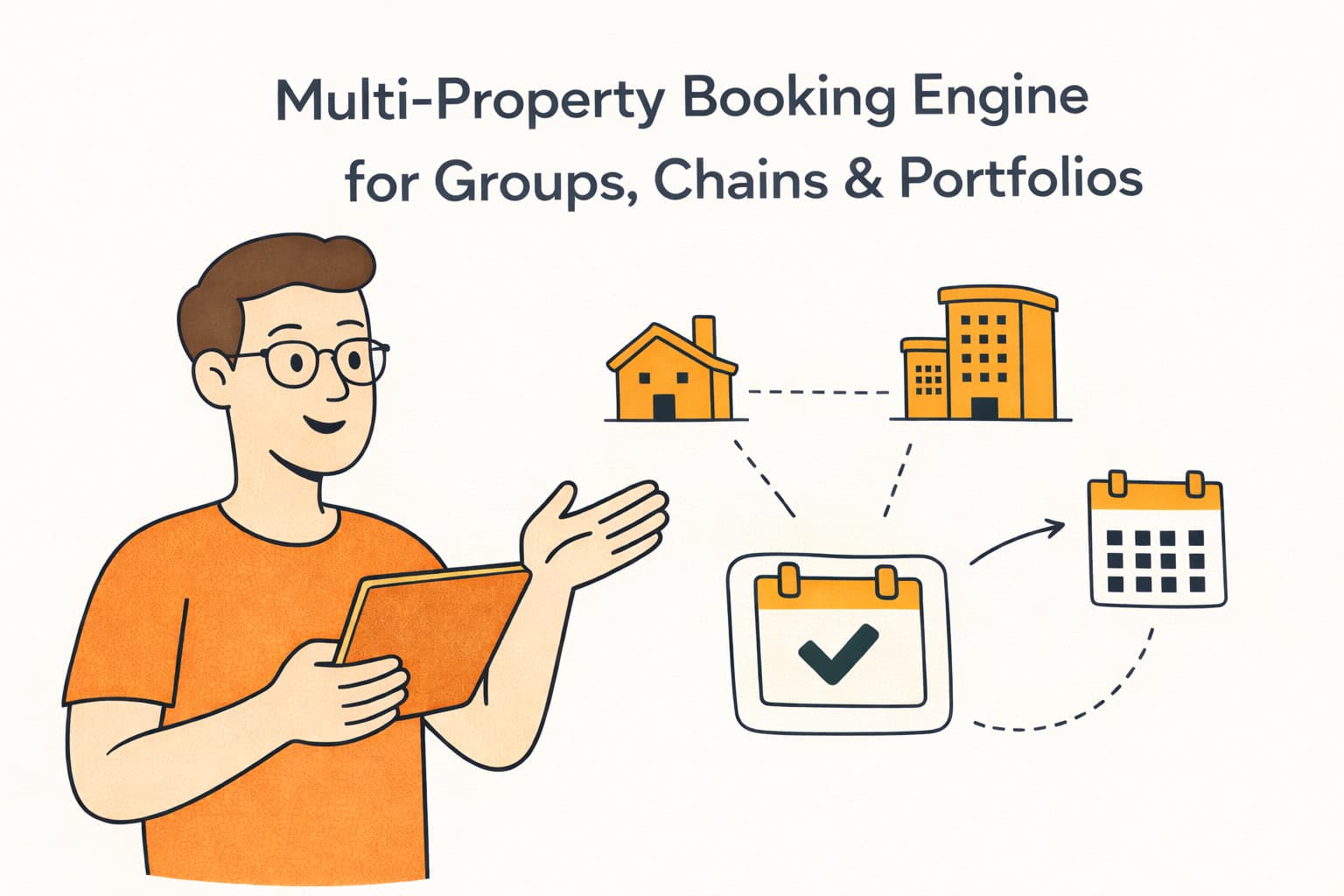
If you manage multiple properties, you probably want guests to browse and book across all of them from a single page — without jumping between separate booking forms. That’s exactly what the Multi-Property Booking Engine does.
It gives you one page where guests can see all your properties, explore them on a map, and book directly — perfect for groups, chains, or portfolios.
Creating a Multi-Property Booking Engine
- Go to your Property Group
- Click on the Booking Forms tab
- Click New
- Give it a name
- For each property in the group, select which booking form to use
- Save
Note: You need at least 2 booking forms to create a multi-property booking engine. Each property in the group should already have its own booking form set up.
What guests see
Once your multi-property booking engine is live, guests land on a single page with everything they need:
- A search form with a property selector, date picker, and guest count
- An interactive map showing all your property locations
- Property cards with cover image and location for each property
When a guest selects a property, they see the full booking form for that specific property — so the experience is seamless from browsing to booking.
Adding it to your website
You have two ways to share your multi-property booking engine with guests:
Option 1: Direct link
Share the URL directly with guests. The multi-property booking engine works as a standalone page — it includes a navbar and a contact section, so it looks great on its own. You can link to it from your website, social media, or email campaigns.
Option 2: Embed on your website
Use the embed code to add the booking engine as an iframe on your website. When embedded, the navbar and footer are hidden automatically so it blends in with your site’s design.
Just copy the embed code from the booking engine settings and paste it into the HTML of your website where you want it to appear. For more details on embedding, check our guide on getting bookings from your website.
Tips
- Set coordinates for each property (in property settings) so they appear correctly on the interactive map.
- Add a cover image and logo to each property for the best look on the property cards.
- Keep booking forms consistent — use similar settings across properties so the guest experience feels unified.
If you already have a Property Group set up, creating a multi-property booking engine takes just a couple of minutes. One page, all your properties, ready to book.